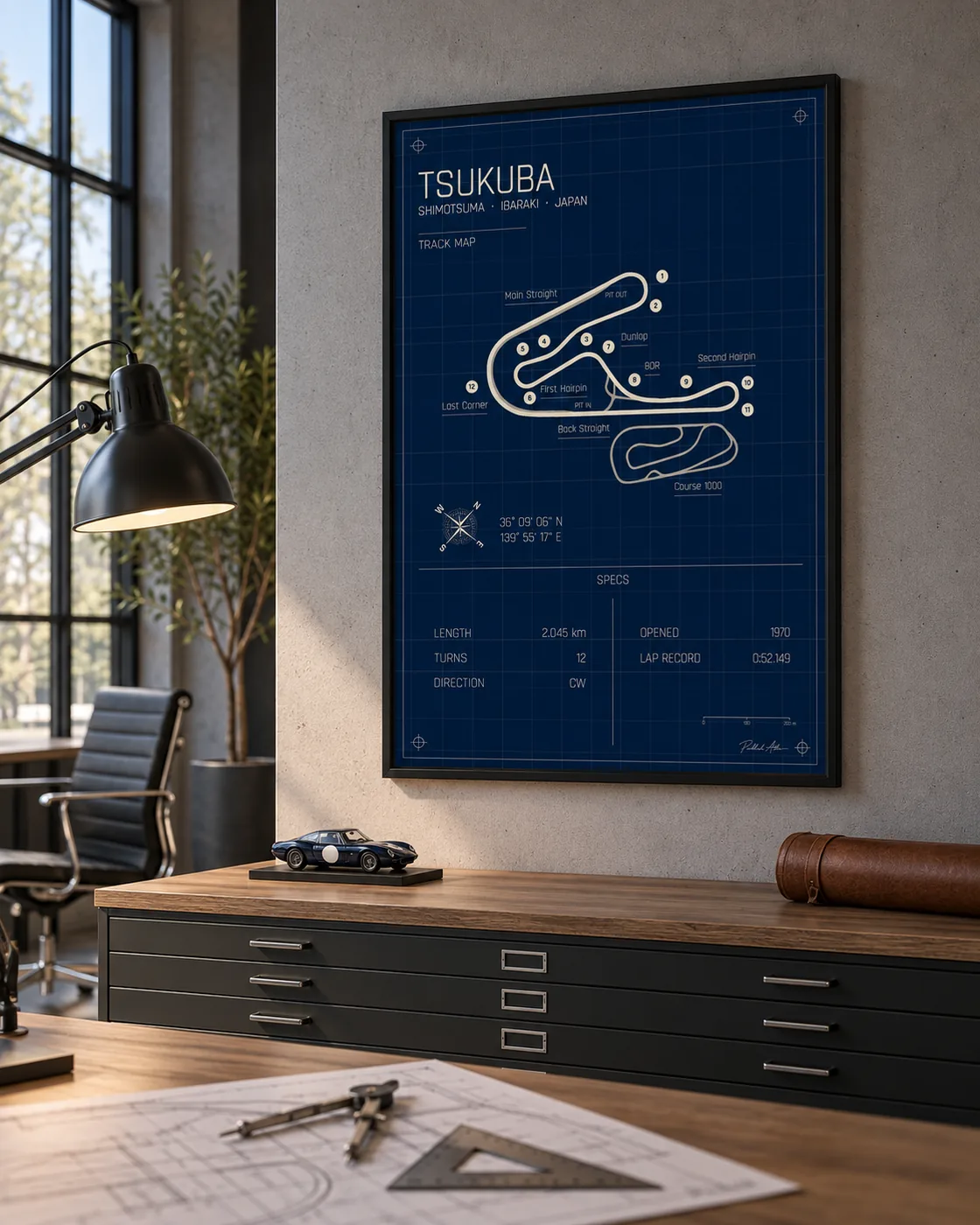
Tsukuba Track Map Poster
Tsukuba — a technical track study of the Ibaraki circuit, drawn as a clean engineering map.
From €29.95
Buy on Etsy ↗Made to order and printed through a global print network, shipped from the hub closest to you. Buy securely through our Etsy shop.
Editions
- Blueprint — Deep technical navy. The drafting-room original — engineering blue, like a blueprint pulled from the archive.
- Heritage — Deep racing green. A nod to the vintage competition clubhouse — wood, brass and worn leather.
- Rosso — Burgundy red. The classic Italian design studio — warm, premium, unmistakably motorsport.
- Midnight — Pure black. The most universal, decorative cut — understated authority for any wall.
Sizes & prices
| Size | cm | Price |
|---|---|---|
| A4 | 21 × 29.7 cm | €29.95 |
| A3 | 29.7 × 42 cm | €39.95 |
| A2 | 42 × 59.4 cm | €49.95 |
| A1 | 59.4 × 84.1 cm | €59.95 |
The story
In Japan, a car’s speed is measured in Tsukuba seconds. When a new sports car or tire comes out, magazines compare it by its lap time on this short circuit, and for car fans that number has always meant something. Tsukuba Circuit runs 2.045 km (1.27 miles) clockwise through twelve turns at Shimotsuma, in Ibaraki.
It began with a foundation set up in 1966, when Japan had far fewer places than Europe or America where ordinary people could try motorsport. The circuit opened on 22 June 1970, eight years after Suzuka and four after Fuji, and it was called Tsukuba seventeen years before there was a city of that name. Its longest straight is only 437 meters (1,434 ft), so a Japanese car, limited to 180 km/h (112 mph), could lap it without hitting the limiter and be compared on equal terms with imported cars. That is one reason it became the magazines’ test track.
The track is a U folded back on itself, as smooth as a billiard table, with hairpins and a final fast curve that seems never to end. The First Hairpin is shaped like a bowl, and the straights are too short to cool the brakes: until the mid-1980s, a Japanese car’s brakes could barely last two or three laps. From the grandstand, the cars pass so close it feels as if you could touch them. And in the paddock canteen almost everyone orders the same thing: the motsu set meal, an offal stew that has not changed since the 1980s.
The poster numbers all twelve turns and letters in five corners and both straights, with the shorter Course 1000 and the pit lane in muted lines. Blueprint, the drafting-room edition, suits a circuit that is, above all, a measuring instrument. Every lap here is a measurement; this one comes drawn to scale.
Poster details
- Region
- Ibaraki, Japan
- Signature corner
- 80R
- Length
- 2.045 km
- Corners
- 12
- On the poster
- The full layout to scale with its named corners lettered in, plus coordinates, a compass, a scale bar and a panel with the circuit’s key figures.
- Paper
- Museum-quality matte archival paper: 250 gsm (110 lb), 0.29 mm thick, acid-free (pH above 7, so it will not yellow over time) and FSC-certified. The matte surface gives deep color with no glare.


