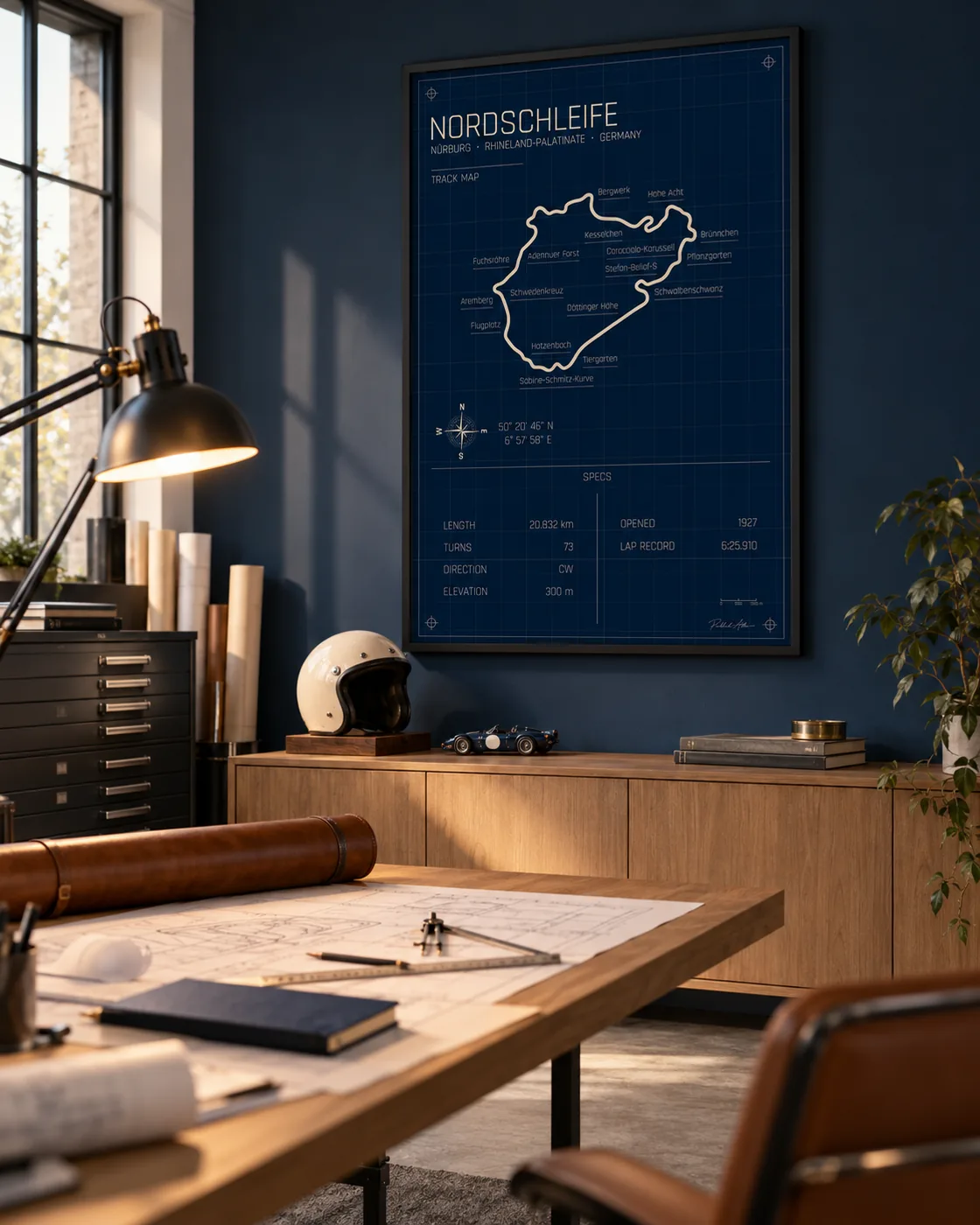
Nürburgring Nordschleife Track Map Poster
Nürburgring Nordschleife — a technical track study of the Rhineland-Palatinate circuit, drawn as a clean engineering map.
From €29.95
Buy on Etsy ↗Made to order and printed through a global print network, shipped from the hub closest to you. Buy securely through our Etsy shop.
Editions
- Blueprint — Deep technical navy. The drafting-room original — engineering blue, like a blueprint pulled from the archive.
- Heritage — Deep racing green. A nod to the vintage competition clubhouse — wood, brass and worn leather.
- Rosso — Burgundy red. The classic Italian design studio — warm, premium, unmistakably motorsport.
- Midnight — Pure black. The most universal, decorative cut — understated authority for any wall.
Sizes & prices
| Size | cm | Price |
|---|---|---|
| A4 | 21 × 29.7 cm | €29.95 |
| A3 | 29.7 × 42 cm | €39.95 |
| A2 | 42 × 59.4 cm | €49.95 |
| A1 | 59.4 × 84.1 cm | €59.95 |
The story
Deep in the forests of Germany’s Eifel mountains, a single lap of the Nürburgring Nordschleife runs 20.832 km (12.94 miles), nearly the distance of a half marathon. It packs in 73 official corners and 300 meters (984 ft) of elevation change, about the height of the Eiffel Tower without its antennas. One of the drivers who won here called it the Green Hell, and the name stuck.
It was built to put people to work. In 1925 the Eifel was a poor region hit by unemployment, and the track was approved as a major emergency works project: more than 2,000 workers carved it through the hills around the village and medieval castle of Nürburg, which gave the circuit its name. It opened on June 18, 1927. Grand Prix cars raced the whole of the Nordschleife, then 22.8 km (14.2 miles) long, until 1976.
Its names are a map of the old landscape. Flugplatz recalls a glider field beside the track, Bergwerk a lead and silver mine, and Fuchsröhre a fox said to have hidden in a drainpipe while the track was being built. At the Karussell, the story goes, a driver hooked his inside wheels into the drainage ditch of the corner in the early 1930s; others copied him, and the ditch became a banking of concrete. It is a toll road, too: on public days anyone with a road-legal car can drive it, and carmakers rent it for up to 17 weeks a year to test prototypes. Yet its race lap record dates from 1983: 6:25.91, an average of more than 194 km/h (120 mph) through the forest.
The poster draws the whole loop as one unbroken line. Seventy-three numbers would bury the drawing, so the turns go unnumbered and seventeen names are lettered in, from the Sabine-Schmitz-Kurve, the first corner of the lap, past the Caracciola-Karussell to the Döttinger Höhe straight. Blueprint, the drafting-room edition, suits a track that carmakers still use as their proving ground. The Green Hell, at last somewhere it can be studied in peace.
Poster details
- Region
- Rhineland-Palatinate, Germany
- Signature corner
- Caracciola-Karussell
- Length
- 20.832 km
- Corners
- 73
- On the poster
- The full layout to scale with its named corners lettered in, plus coordinates, a compass, a scale bar and a panel with the circuit’s key figures.
- Paper
- Museum-quality matte archival paper: 250 gsm (110 lb), 0.29 mm thick, acid-free (pH above 7, so it will not yellow over time) and FSC-certified. The matte surface gives deep color with no glare.


